
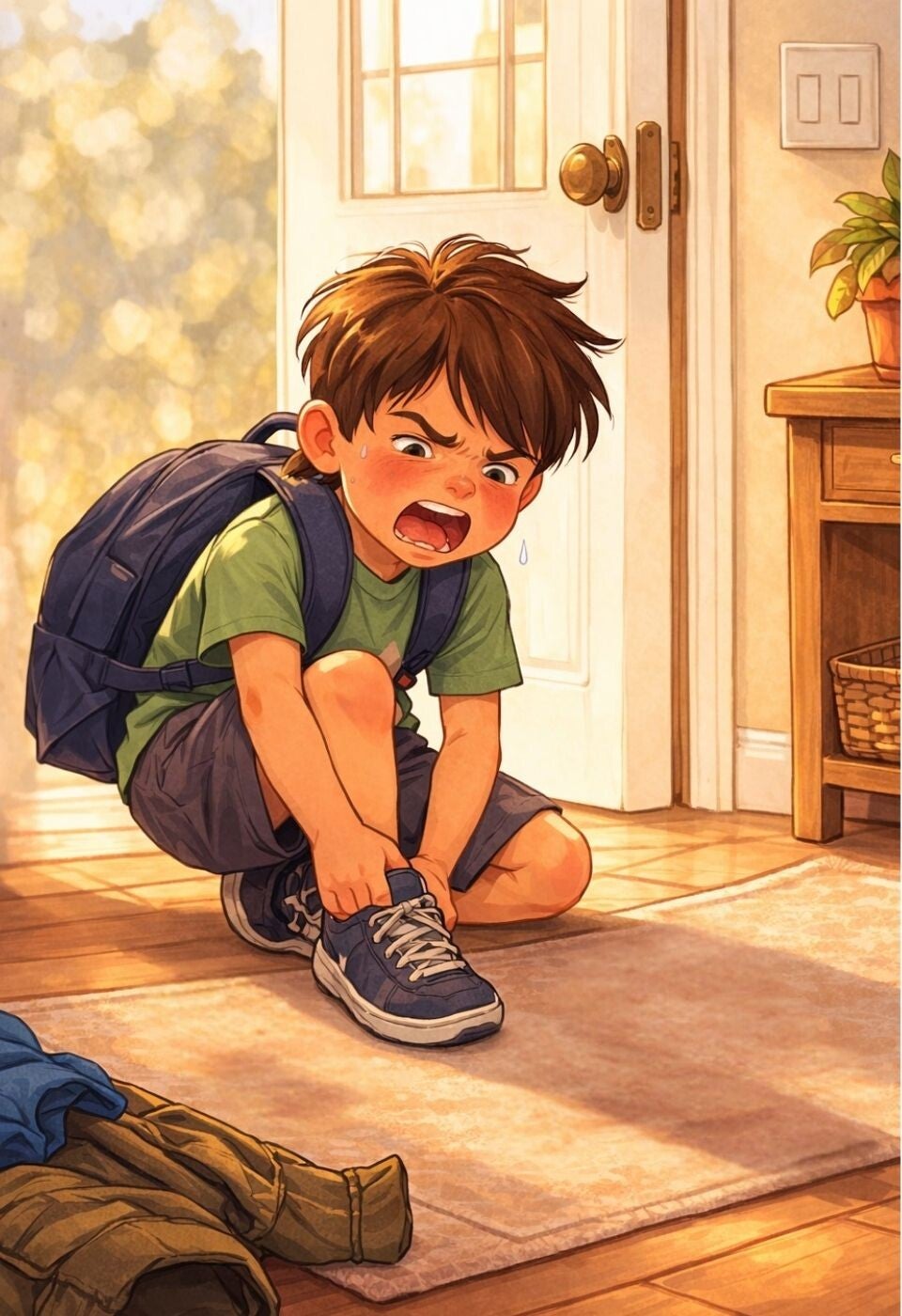
A lot of us notice the same frustrating pattern.
- Our kids hold it together all day at school.
- Teachers say they behaved well.
- No big problems.
- Everything seemed fine.
Then they walk in the door at home… and suddenly the smallest thing sets them off.
- You ask how their day was. ➡️ They snap back.
- You remind them to take off their shoes. ➡️ Cue tears.
- You suggest homework. ➡️ Total meltdown.
If this sounds familiar, you’re not doing anything wrong, and our kids probably aren't trying to be difficult either.
There’s actually a very common reason this happens.
What’s Really Going On
School takes a huge amount of mental energy for kids. Think about what they’re managing all day:
- sitting still
- listening to instructions
- switching between subjects
- dealing with noise and busy classrooms
- navigating friendships and social rules
- trying not to get in trouble
That’s a lot for a developing brain. All day long, kids are holding it together.
- They’re following rules.
- Managing emotions.
- Trying to do the right thing.
By the time school ends, a lot of that self-control is simply used up, so when they finally get home — the place where they feel safest — everything they’ve been holding in during the day finally spills out.
Psychologists sometimes call this after-school restraint collapse, but most parents just call it:
“Why is my child melting down the second they walk through the door?”
Why It Happens at Home
If our kids behaved well at school all day, why are they falling apart with us?
It’s easy to feel like our kids are saving their worst behavior for home, but in many cases, the opposite is true.
- Home is the place where they finally feel safe enough to stop holding everything in.
- At school, they have to manage it.
- At home, they finally let it out.
That emotional release can look like:
- anger
- crying
- frustration over small things
- refusing simple requests
- shutting down completely
It’s not usually about the shoes, the snack, or the homework. It’s about the entire day finally catching up to them.
Some Kids Work Even Harder During the Day
All kids can feel drained after school, I know I did, but for some children, the effort required to get through the day is much higher. This can happen when a child:
- works really hard to follow rules
- struggles to process social situations
- feels overwhelmed by noise or busy environments
- spends a lot of energy trying to “fit in”
From the outside, our kids may look like they’re doing great at school, but keeping everything together can take an enormous amount of energy.
Later on, we’ll talk more about things like masking and burnout, which can play a role for some kids. For now, it’s enough to know that a calm school day doesn’t always mean an easy one.

What Meltdowns After School Can Look Like
Not every kid reacts the same way.
- Some explode.
- Some shut down.
For many, the hardest part of the day isn’t school itself.
It’s the transition afterward.
We often notice things like:
- irritability the moment school ends
- emotional reactions to very small problems
- refusing simple tasks
- saying “I’m fine” but clearly not being fine
- wanting to be left alone
What Actually Helps
When we understand what’s happening, the goal shifts. Instead of trying to stop the meltdown, the goal becomes helping them recover from the day.
A few small changes can make a big difference.
Time to Decompress
You know how it feels to finish a long, stressful workday and immediately having a list of chores to do?
Kids often feel the same way after school, they’re just still learning how to handle that exhaustion.
A short decompression period helps their brain reset. That might look like:
- having a snack
- quiet play
- time outside
- drawing, building, or listening to music
Even 20–30 minutes of downtime can change the whole afternoon.
Hold Off On Questions
We naturally want to know how school went, but right after school, some kids simply don’t have the mental energy to explain their day.
Instead of leading with questions, try something simple:
“I’m glad you’re home.”
Later, once they’ve relaxed, they’re often much more willing to talk.
Watch for Patterns
After a while, you may start noticing patterns.
- Maybe certain days are harder.
- Maybe certain classes drain them more.
- Maybe social situations are exhausting.
Paying attention to these patterns can help you understand what parts of the day are the most demanding for your child.

Key Takeaway
When kids melt down after school, it’s easy to think they’re being dramatic, disrespectful, or manipulative, but often the opposite is true.
Many children spend the entire school day working incredibly hard to regulate themselves, by the time they get home, the tank is empty, and the meltdown isn’t about defiance. It’s the moment their nervous system finally says:
“I can’t hold this in anymore.”
Once we look at it that way, the goal shifts from stopping the meltdown to helping our child recover from the day, and that small shift can make afternoons feel a lot calmer, for both of you.